
Santa Ana Gas Line handles gas meter relocations and meter upsizing throughout Santa Ana, California, working alongside SoCalGas on the utility side and taking care of the customer-owned piping, the permit and the inspection on ours.
A meter moves for one of a few reasons: a wall is coming down, an addition is going up, a driveway or hardscape is being reworked, or the meter is simply in the wrong place and always has been. A meter is upsized for a different reason — the building has outgrown its supply, usually after a tankless heater, a pool heater or a standby generator was added.
Both are jobs with two owners. The meter set assembly and everything upstream of it belongs to the utility. Everything downstream is yours. That split means the work has to be sequenced between two parties, and most of the delay people experience on these jobs comes from the sequencing rather than the work itself.
Relocating a Meter
Establishing Where the Boundary Sits
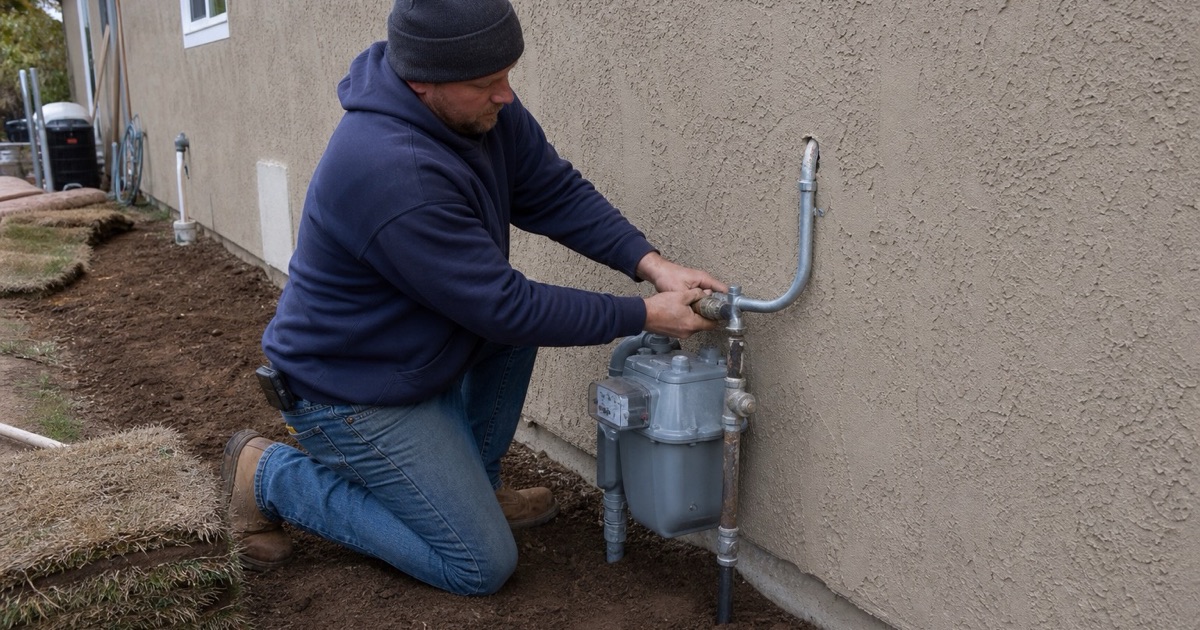
Before anything is planned we establish exactly where the service delivery point is and what is on each side of it. The utility owns and moves the meter set; the houseline that leaves it is ours to re-run. Setting that out clearly at the start is what stops a customer being quoted twice for the same section, or waiting on a utility for work it was never going to do.
Re-running the Houseline
When a meter moves, the customer-owned piping that fed from its old position has to be re-run to the new one, and this is usually the larger half of the job. It is also an opportunity: the run is being replaced anyway, so it can be sized for what the building actually carries now rather than reproducing the original limitation in new pipe. We size it from the connected load.
Sequencing With the Utility
The utility’s visit and our work have to land in the right order, and that order depends on the specifics of the site. We plan it with you and coordinate the timing rather than leaving you to be the go-between on two schedules. Where the meter is at the curb and the run to the house is long, the trenching is scheduled so the ground is open when it needs to be and not before.
Hardscape, Trenching and Restoration
A relocation frequently involves a new underground run, which means a trench across ground somebody cares about. New polyethylene goes in at depth with tracer wire above it so it can be located later, and the ground is backfilled and compacted in layers. Hardscape, turf and planting go back the way we found them rather than as a patch that settles over the winter.
Upsizing a Meter
Working Out What the House Now Needs
Upsizing starts with arithmetic, not with a phone call to the utility. We add the connected load of every appliance — including whatever prompted the question — and establish whether the shortfall is at the meter, in the piping, or both. It is frequently both, and it is not unusual for the real constraint to turn out to be a branch rather than the meter that was blamed.
When the Line Is the Real Problem
An undersized branch produces exactly the symptoms people attribute to a small meter: pilots dropping out, a water heater going cold when the furnace fires, an appliance that never quite performs. Establishing which it is before requesting utility work saves the cost and the wait of a meter change that does not fix anything. That measurement takes an hour with a manometer and a sizing calculation.
Generators, Pool Heaters and Tankless Units
These three are behind most upsizing requests, and a standby generator is the most demanding of them because it has to deliver full output at the same time as everything else in the building. We calculate the total connected load before you order equipment, so you find out whether you need a larger line, a larger meter, or both while it is still a planning decision rather than a problem.
Permits, Testing and Sign-off
The Permit Side
Work on the customer-owned piping is permitted through the City of Santa Ana’s Planning and Building Agency, and a temporary gas meter, where one is needed to keep a property in service, is a $310.64 line item on the city’s fee schedule. We pull what is required, show the fees on the quote, and meet the inspector.
Testing and Getting Back On
The re-run houseline is charged and held under test pressure before it is signed off, and you keep the written result. Once the utility has set the meter and restored service, every appliance is relit and checked in turn, with the delivered pressure verified while each one is firing. That final pass is ours, and it is what turns a completed meter move into a working building.
- Licensed & Insured
- Same-Day Leak Response
- Free Written Quotes