
Santa Ana Gas Line installs and replaces buried gas piping throughout Santa Ana, California — runs to pool and spa heaters, outdoor kitchens, fire features, detached garages, casitas and accessory dwelling units, and the yard line from a curb-set meter back to the house.
Underground work is a different trade from interior piping, and the difference is not the digging. It is the material, the depth, the protection, and the fact that once it is covered nobody can see it again. Everything that makes a buried line findable and durable has to be done while the trench is open, because there is no second chance at it.
The ownership question comes up more here than almost anywhere. Where a meter sits at the curb rather than against the house, the entire run from the sidewalk to the building is customer-owned pipe — often the longest and oldest section of the whole system, and routinely assumed to belong to the gas company.
Getting a Buried Line Right
The Right Material Below Grade
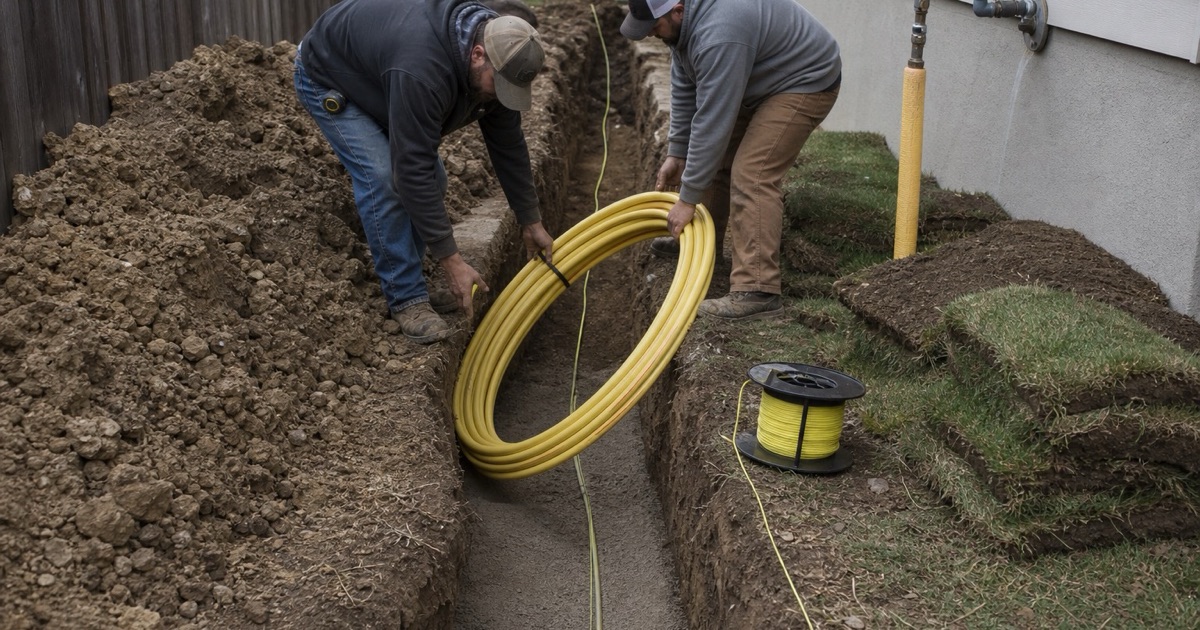
Below grade the material is polyethylene, in PE 2708 or PE 4710. It does not corrode the way steel does in wet ground, which is precisely why buried steel from the 1960s is now failing across this city. Polyethylene cannot come above ground, so the run transitions to steel at an anodeless riser where it surfaces. Getting that transition right is where a lot of older underground work went wrong.
Depth, Bedding and Backfill
A buried line is laid at depth on bedding that will not damage it, then backfilled and compacted in layers rather than simply pushed back in. Compacting properly is what stops the trench settling into a visible scar across a lawn or a driveway over the following winter, and it is the single most common shortcut on this kind of job. It costs time on the day and nothing afterwards.
Tracer Wire So It Can Be Found Again
Polyethylene is invisible to a locator, which is why tracer wire is laid above the pipe. Without it, the next person who needs to find that line — you, a landscaper, a pool contractor, or us in ten years — is guessing. Buried lines get struck because nobody could establish where they ran, and a few dollars of wire in an open trench is what prevents that.
Locating Before Anyone Digs
Every excavation is preceded by a locate. An 811 DigAlert ticket brings the utilities out to mark their own facilities, and SoCalGas marks only as far as the meter. The customer-owned yard line — frequently the one running straight across where you intend to dig — is not on that ticket and is not marked by anybody unless a private locate is arranged. We do that ourselves.
Common Underground Runs
Pool and Spa Heaters
A pool heater is one of the largest single loads on a residential property and usually sits at the far end of the longest run, which is the combination that produces an undersized supply. We size the line for the heater’s rated input across the real distance to the equipment pad, so the unit reaches temperature rather than short-cycling on inadequate pressure.
Outdoor Kitchens and Fire Features
Built-in barbecue islands, linear fire tables, fire bowls and low fire pits inside seat walls all need a buried supply arriving in the right place before the hardscape is built. We coordinate with whoever is constructing it so the stub is positioned and the trench is done while the yard is still open, rather than chasing pipe in afterwards through finished stone or stucco.
Detached Garages, Casitas and ADUs
A detached building needs its own run, sized for everything it will contain and terminated at a shutoff at the building. Accessory dwelling units in particular are frequently specified with a kitchen and a water heater, which is a real load rather than a token one, and the run to them is long enough that sizing by eye goes wrong.
Replacing the Yard Line From the Meter
Where the meter is at the curb, the run back to the house is yours, it is usually original, and it is the section most likely to have corroded. Replacing it is a trench, new polyethylene at depth, tracer wire above, and a transition at each end — and when we are done, the ground goes back the way we found it.
After the Trench Is Closed
Testing Before Anything Is Covered
A buried run is pressure tested while the trench is still open, because a line that fails its test after backfill is a second excavation rather than an adjustment. We charge the section and hold it on a gauge whose range is no more than twice the test pressure, watch it, and only then call for the inspection. Doing the test and the inspection in the right order is what stops an underground job being dug twice.
Photographs and a Route Record
Before the trench is closed we photograph the route and the depth, and you keep those images. It costs nothing on the day and it repeatedly saves the next trade — a landscaper, a pool contractor, an electrician trenching for a subpanel — from finding the line the hard way. On a buried run this record is worth more than on any interior work, because there is no other way to know afterwards where the pipe actually went.
Restoring the Surface Properly
The pipe is our work but the yard is what you look at. We backfill and compact in layers so the ground does not settle into a trench-shaped depression over the following months, and we put hardscape, turf and planting back rather than leaving a strip of loose soil and a promise that it will settle. Where pavers or concrete came up, they go back as a repair that is meant to be permanent.
- Licensed & Insured
- Same-Day Leak Response
- Free Written Quotes